Examining the Overarching Applications and Integration of Robots and Robotics Technology

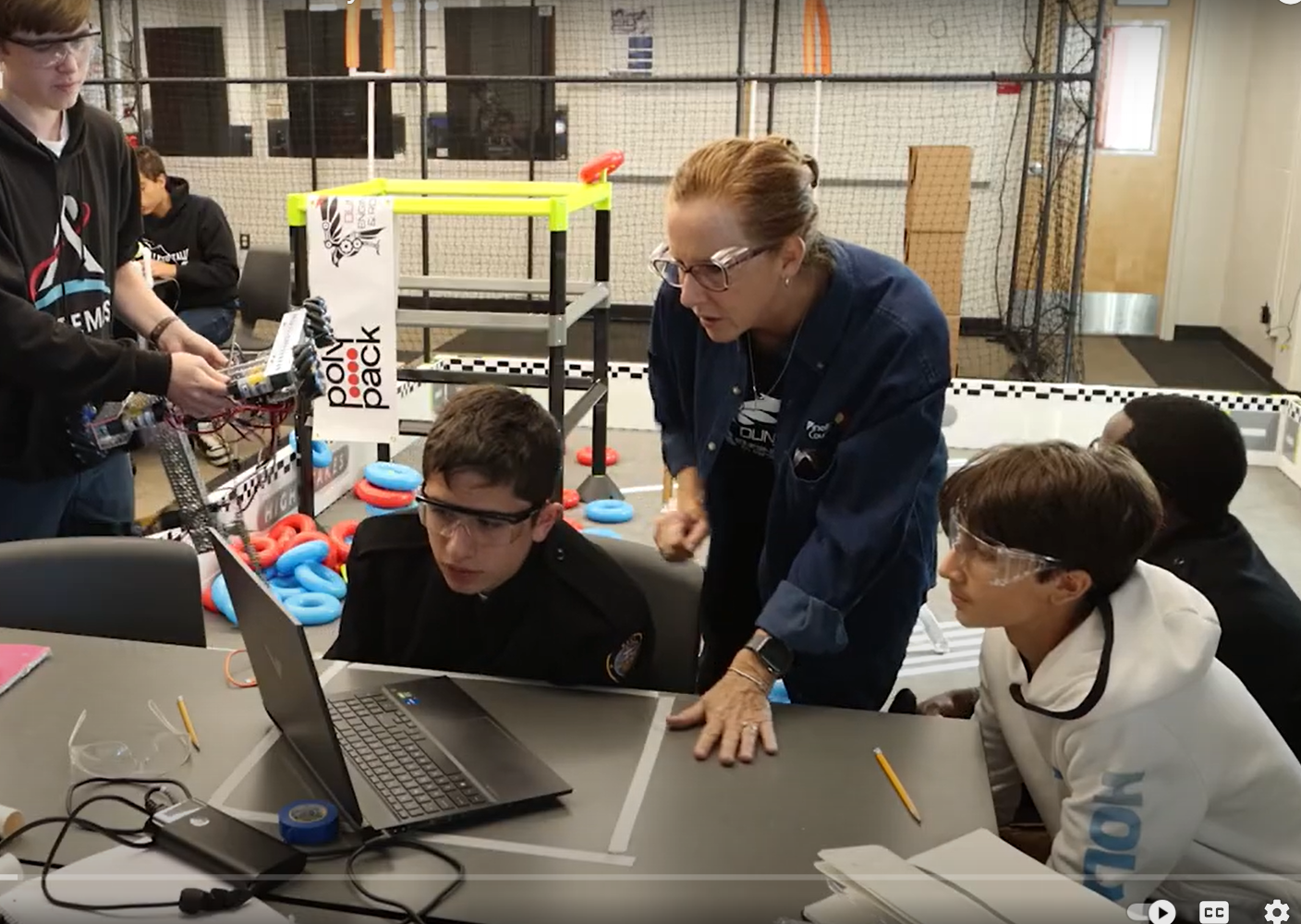
Across the country and in the great state of Florida, robots have been a nexus of thousands of youth of all ages. They have stolen the hearts of so very many, both young and old. Intramural and competitive teams in dozens of different leagues and organizations rival sports teams for their popularity. School districts across Florida are trying to find the best way to provide access to robotics for all their students. They are trying to find ways and means to have as many teachers as possible trained in robotics so they can use robots to teach science, technology, engineering and math (STEM) principles and processes as well as “robotics technology.”

Robots offer a single platform to teach STEM subjects both individually and/or integrated together. There
are a lot of fundamental processes and principles of STEM at multiple levels in designing, building and programming robots. Problem and project-based learning come to life when using robots to help students learn. In the context of this integrated, contextual learning, students can learn by discovery and develop creativity necessary for invention. Robotic platforms require students and teachers to develop strong soft skills including communication skills and teamwork. Robots are also ripe platforms for developing trouble-shooting skills.

Robots can now be found everywhere in many industrial and business sectors with innumerable applications. Close your eyes and just imagine a job you don’t like to do because it’s tedious, repetitive, dangerous, or just plain boring! On that same token, what do robots do for manufacturers? From the moment materials arrive to be processed until the final products leave the manufacturing plant, robots help get many jobs done. They are used for stacking and retrieving components for assembly as well as for storing final product inventory in warehousing settings. They do welding, assembly, inspections, filing, packaging and labeling. Robots can be designed to do almost any task you can imagine.

Valpak in Pinellas County has a state-of-the-art “warehouse” where bundles of sorted blue envelopes wait for their mail date to arrive. Once these are picked up, an unmanned robotic vehicle makes it way down a long narrow aisle to collect the desired pallet. The box is retrieved from storage by another robot that identifies the pallet, moves it from the shelf to the vehicle, and confirms if it is the correct pallet and vehicle using tracking devices. The unmanned vehicle delivers the goods to a conveyor, which takes it to the loading docks. Technically, this is called an “automated storage and retrieval system,” or ARS with robots being just one of the key components to make it all happen.

Farther south on Florida’s east coast, Hoerbiger Corporation, is just one of many manufacturers that have recently installed robotic assembly lines. One such line assembles valves that are part of the compressor system of ThemoKing refrigerated vehicles. Components produced in other parts of the facility, make their way to this cell where five robotic arms, multiple part feeders, sensors work in unison to assemble all parts. It’s amazing and mesmerizing to watch.

The USF CAMLS (Center for Advanced Medical Learning and Simulation) in Tampa is teaching surgeons
the latest techniques for robotic surgeries. In Ocala and Pensacola, the Institute for Human and Machine Cognition (IHMC) pioneer technologies aimed at leveraging and extending human capabilities, often with robotic applications. Every university in the state has research engineers and scientists working in centers focused on some aspect of robotics including machine intelligence, nonlinear controls, and robotic mechanical systems. Material science and technology is another important aspect of robotics that focusses on determining the best material to use for a robot doing a particular job.

There are many more examples of robotic research and production activity in Florida. Given its prominence, it is important to help students understand that robots are not just for fun. They can be used as a platform to teach STEM concepts, and as such, comprise growing numbers of career opportunities that support Florida manufacturing businesses. Industrial robots have also raised the bar for many manufacturing jobs and careers. Manufacturing technicians today need to have a working knowledge of how different machines work independently and/or in cohort with each other and with people via computer codes. Students can focus their studies on the mechanical parts, electrical parts, or the communication part of a robot.

Now that you are well versed with robots, the technology behind them, and their applications, I invite you to read rest of the stories in this special, robotics-centered edition of the FLATE Focus. From our report on national robotics week, to our observations on what it takes to be a 21st century robotics technician we explore every aspect of robotics and its impact on students, educators as well as industry. For those inclined toward renewable and alternative energy related news bytes, tune in to our story about upcoming energy camp offerings, or sign up and go green at the “Greentech for Girls” summer camp for teachers. Before time and space runs out, do consider robotics camps for your students, and as always take a stab in solving our sTEm puzzle of the moth. These and many more stories in this edition of the FLATE Focus.

Relevancy of Robotics in sTEm Education

Everyone loves to see robots in action, but how are they relevant, perhaps even critical to Science, Technology, Engineering, and Math (STEM) education? Programs such as FIRST® Robotics are growing by leaps and bounds in schools nationwide, and “robotics” is a popular summer camp offering. Why? Kids love robots! And when students ask to be part of an activity that teaches not only STEM curriculum, but learning and teamwork, parents love them too. FLATE’s Robotics camps have been an important part of FLATE outreach to middle and high school students since 2005 and have served 587 campers to date.

Part of FLATE’s National Science Foundation mission is to provide education and experiences promoting
Florida advanced manufacturing college and career pathways, and for many students, the educational punch packed by robotics camp is an ideal way to jumpstart the process toward interest in adding more STEM subjects in school. As well, while math and science subjects abound, technology and engineering subjects, especially in middle school, may be harder to find. Robotics camps and programs are stepping up to fill the void in technical and engineering education (the T & E side of sTEm), for the average middle school student. Parents of summer campers have let FLATE know, through surveys, that schools are not offering enough technology, engineering, and robotics curriculum and coursework, and parents wish this would change. In response to this articulated need, FLATE has developed curriculum focused on industry connected high tech manufacturing scenarios (based on real Florida companies) and also uses summer robotics camps and open house events in HCC’s high tech engineering technology lab to raise awareness about technology and engineering college and careers using robots as one hook to engage and interest students.

Early exposure to robotics through camps, competitions, and sTEm programs, especially if not offered as part of traditional school curriculum, introduces students to the world of automation and provides the opportunity to explore high tech industrial careers and inventive concepts and applications. In speaking about robotics camps, Dr. Row Rogacki, Institute for Human and Machine Cognition, believes camps “meet a real need for local students interested in technology.” Indeed, school budgets may present an obstacle for providing state-of-the art “hands on experiences” using equipment in the classroom, and this has contributed to the technology and engineering gap in secondary technology education. New models have high schools working with colleges for laboratory resource sharing, dual enrollment, and partnerships with vendors.

Another important consideration for promoting technology relevant robotics curriculum in schools is
introducing middle and high school teachers to advanced technology curriculum, such as 3-D modeling, and providing teachers with the background, learning resources, and partnerships they need to provide relevant sTEm curriculum using robotics and automated processes. To this end, FLATE hosts engineering technology summer institutes, summer camps for teachers, and sTEm workshops for teachers. Teacher workshops in recruitment strategies for girls to STEM curriculum and “Green” technologies are popular with advisors as well as teachers. As a parent recently shared, “[robotics] is a program that should and could be incorporated in the school systems – it is learning, fun, and hands on which is needed in our students education.” Involving all levels of education providers, as well as parents in awareness of the relevance of technology, engineering, and robotics is critical to supplying tomorrow’s high tech workforce.

To register for FLATE’s 2013 Summer Institute, contact Dr. Marilyn Barger at barger@fl-ate.org,. For more information about FLATE’s 2013 Summer Camp for Teachers, GreenTech, contact Dr. Marie Boyette at mboyette3@hccfl.edu. To register for the 2013 “All Girls” and other robotic camps, visit our website at http://www.fl-ate.org/projects/camps.html, or contact Desh Bagley, outreach manager at bagley@fl-ate.org.

sTEm–at-Work Puzzle #34: Valve Selection for OJ transfer

A process technician for Tropicana in Bradenton, Florida is part of a team that is renovating a major transfer line from the juice processing plant to the packaging facility. The task at hand is to install a value with its computer controlled actuator. The technician knows that the value to be installed must have minimal impact on the juice flow when it is just starting to open to avoid unwanted plugging of the nozzles delivering juice to their containers. The Technician also knows that this project only involves two choices for valves; the “U-Betch-Em –V222 and the “U-Betch-Em” V333. The Tech examines the intrinsic valve characteristics plots provided by “U-Becth-Em” and immediately knows which valve is the correct valve for this application.


The technician installed the “U-Becth-Em V222. YES or NO.

Submit your answers under this blog post, or post it on www.fl-ate.org.


What It Takes to Be a Robotics Technician: The Nuts & Bolts

Just what is inside a robot and whatever does it take to be a robotics technician? In a quest to answer this
question for students and parents attending the recent FLATE’s national robotics week open house, FLATE’s Executive Director, Dr. Marilyn Barger, started with the O*Net site for robotics technicians. The official NAISC code is 17-3024.01—Robotics Technician, and the short (but official) definition of this occupation is someone who builds, installs, tests, and/or maintains robotic equipment, or related automated production systems.

The summary report for this occupation (and all others in the O*net) is presented to readers in concise
statements in the following categories: tools and technology; knowledge; skills; abilities; work activities; work context; job zone; education; interests; work styles; work values, and related occupations. There are also links to job openings and job search engines as well as national wage data. Click here to go to the robotics technician page. There is a lot more information that you can download if you look behind the “details” tab. This tab also reveals how important and how frequent the various work activities are.

According to O*net, here is what robotics technicians need to know, what they need to be able to do, and some of their work activities. This is all a pretty technical description of a robotics technician. You can find more visual video descriptions by watching one of the “Made in Florida” videos, on “robotics technicians”. You will also get to see the very cool, high-tech manufacturing workplaces where robotics technicians work.

click to enlarge image
Starting with salary and wages, and employment, you can find out that the average 2012 annual wage for
this occupation is $51,820, and that there are approximately 16,000 people in the U.S working in that occupation. Not surprisingly, the 3,200 openings anticipated in this decade (2010-2020) are primarily in manufacturing and scientific and technical services. There is also a link to a much related occupation of electromechanical technicians and nearly 70% of the 16,000 robotics technicians have an Associate’s degree. Students can find good jobs as robotics technician after completing an Associate’s degree in engineering technology in Florida with one of several specialized tracks: advanced manufacturing; electronics; or digital design, or others at a state or community college near you

For more information visit www.madeinflorida.org, and www.fl-ate.org, or contact Dr. Marilyn Barger, executive director of FLATE at barger@fl-ate.org, and Dr. Marie Boyette, associate director of FLATE at boyete@fl-ate.org.