All Girls Camp Sets Campers on a Path of Exploration & Innovation

FLATE’s All Girls Camp is a big news maker every summer. The Camp draws focus on an important topic that highlights the relevance of STEM (science, technology, engineering and mathematics) in real-world settings, and more importantly, echoes the need for women to be engaged in STEM and robotics. “From cloud computing the next step is robotics” said Burt Ginampos whose daughter Felize Ginampos attended FLATE’s ‘All Girls’ camp last month. Ginampos echoed the sentiments of several parents who pointed the camp has served as a ‘hook’ in getting their daughters curious about STEM and excited about robotics, even those campers who stated their natural calling isn’t particularly mathematics or science.

For example, Monique Joseph who stated attending the camp stirred her curiosity about robotics, but candidly
admitted she “does not enjoy science, or math” per se. To that end, the robotics camp is aimed at developing a passion for STEM among existing STEM enthusiasts, but more importantly targeted to bolster a shift in thought towards STEM. How does the FLATE robotics camp achieve this, or what role does the camp play in getting students’ curiosity fired up about these topics?
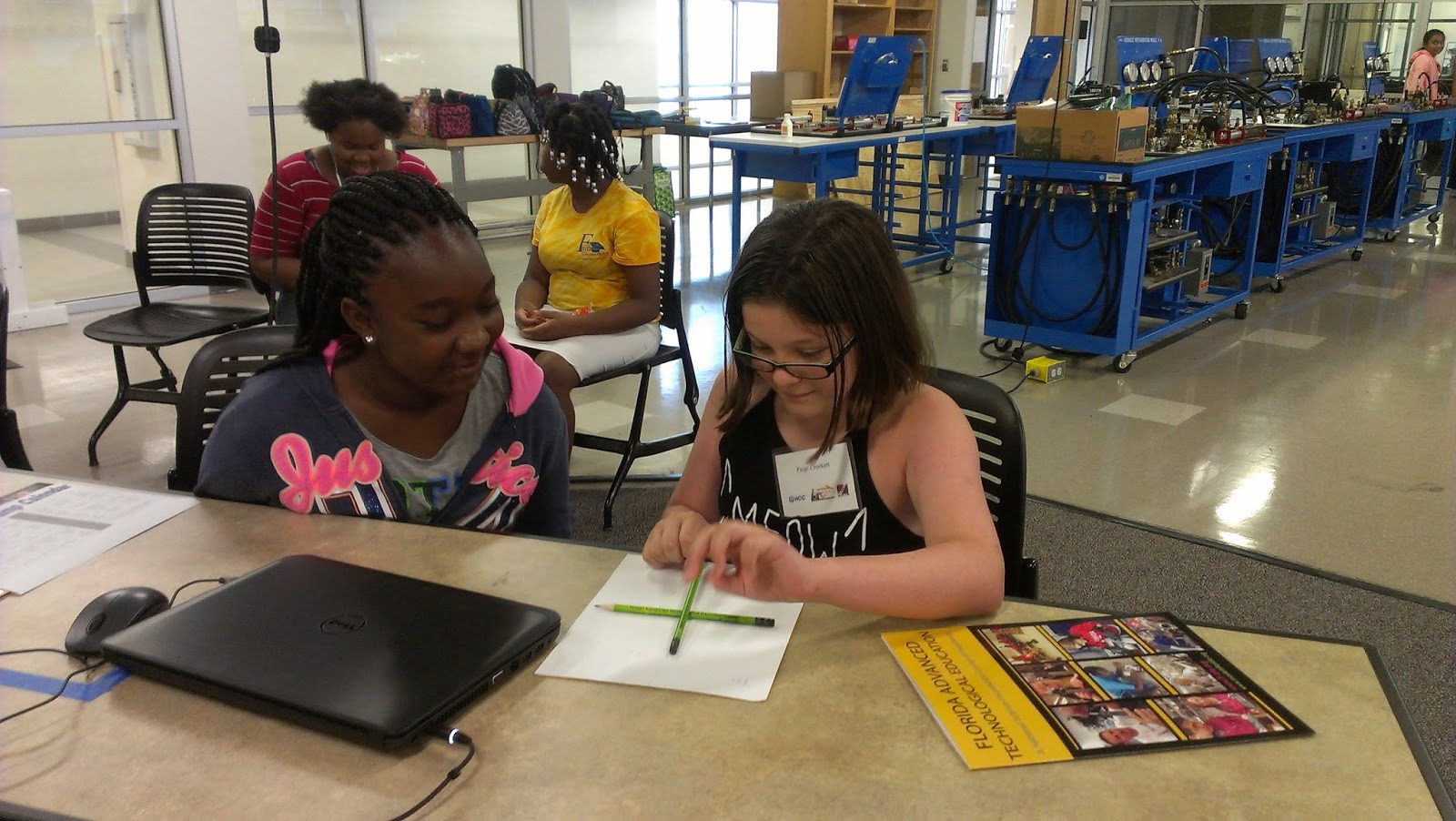
A core part of FLATE’s strategy to engage students, particularly girls, in STEM has been through problem based learning where girls can work in a collaborative, team-based environment. “The challenges are hard, but I really enjoyed it” said Felize Ginampos. Another camper, Dariya Bagley, also stated she enjoyed the challenges because it “made her think.” Through hands-on exercises that showcase real-life applications of STEM and robotics, the challenges consistently reflect what experts across the board agree is an effective mechanism in creating a “hook” for students to get them interested in STEM. The ‘hook’ in this case was of course the robot, and the added excitement for most campers was programming the robot to work through various challenges.

Besides learning about programming and real-world applications of STEM, another valuable take away from the
camp was developing problem-solving skills and teamwork that are critical in any workplace. “I hope she learns how stuff is made from a technical standpoint, but also learns how to work in a team” said Amit Sehra, whose daughter Aarushi was programming robots for the first time. Felize, who already knew about programming robots liked the camp as it gave her the chance to meet new people and at the same time challenged her to think beyond what she already knew about programming.

To enhance campers’ experience and give them a first-hand view of what it is like to work in high-tech manufacturing settings, campers were taken on a “Made in Florida” industry tour of Publix Dairy in Lakeland, FL, where they witnessed STEM concepts being applied in various manufacturing processes. The tour was a game changer in more ways than one. “My visit to Publix completely changed my mind” said Marissa Stanley who added she’ll “never look at milk the same way.” Indeed touring a high-tech manufacturing facility left a deep imprint on most campers, with most making connection between theoretical concepts learned in class, during the camp and their real-world applications. ‘I thought it was cool to see how efficiently the machines and robots worked” said Camille a 6th grader at Burns Middle School. Dariya Bagley who grew up around computers and robots stated visiting the Publix manufacturing facility changed her opinion about factories having a lot of people working. Instead what she saw were more machines and robots.

Indeed, FLATE’s “Made In Florida” industry tours are geared to educate students about modern manufacturing
tools and practices, and showcase production environments and automated processes that require similar soft skills and technical skills in robotics and programming that they learned during the camp. In an ongoing effort to reach out to minorities and students from economically challenged backgrounds, and spark their interest in STEM, FLATE once again partnered with Suncoast Credit Union Foundation to provide scholarships to girls from low income families to attend the robotics camps. The mission of the scholarship is to” improve the lives of children through education, health, or emotional well-being” said Cindy Helton, executive director of Suncoast Credit Union Foundation.

The Foundation offered 14 scholarships this year on a first come, first served basis, and since the inception of the program and partnership with FLATE has served as a pathway for recipients to avail of opportunities that would not be possible without financial support from the Foundation. “STEM is one the fastest growing professions and these girls need to know/get interested and excited about the opportunities” said Helton. Since the inception of their program, Suncoast Credit Union Foundation has donated over $13 million dollars to community based organizations supporting women and girls in STEM, with $2.2 million in donations in 2014 alone.

Post event surveys from the camp show 100% of the campers agree that programming the robot helped them see
how automated systems are programmed and controlled. One hundred percent of the campers also stated the camp provided opportunities for teamwork and collaborations with others. Over 95% stated the camp helped them better understand how STEM concepts/principles are used in industry/real-world settings.

For more information about the robotics camps and the “Made in Florida” industry tours for middle and high school students visit www.fl-ate.org and www.madeinflorida.org. For information on upcoming FLATE robotics camps and robotics-related professional development opportunities for educators contact Dr. Marilyn Barger, executive director of FLATE at barger@fl-ate.org and Desh Bagley, outreach manager and camp director at bagley@fl-ate.org

Advanced Manufacturing Institute Serves as a Highway Connecting Manufacturers and Educators

Manufacturers and educators are closely tied by some common goals. Now more than ever manufacturers and
educators are finding themselves standing on common ground looking to align towards each other’s needs. On one end of the continuum are educators who are looking to streamline curriculum to match local workforce needs; while on the other end of the same continuum are industry professionals who are depending on educators to equip and train students with credentials and ready-to-work skills that meet their current workforce needs. In an effort to bridge and/or lesson the gap between the two ends of this spectrum, FLATE recently hosted a summer Career Institute for educators that served as a common platform for industry and educators to openly discuss ideas and strategies to develop curriculum and training modules that match manufacturers’ needs.

The three day Institute involved 84 participants that included teachers, manufacturers and industry leaders
from across Florida who convened to share ideas and best practices and formulate streamlined education modules. “Like all good educators I want to see what the other educators are doing successfully” said Russ Henderlite, teacher at Frank H. Peterson Academies of Technology in Jacksonville, FL. The workshop was infused with hands-on activities that centered on additive manufacturing, SolidWorks and 3D printing exercises targeted to give educators a hands-on perspective on cutting-edge manufacturing practices currently implemented by high-tech manufacturers across the state. “I loved the workshop as it gave me a real-world view of manufacturing and helped identify the gaps between education and employment” said Selena Lewis, Project Lead the Way teacher at Young Middle Magnet School in Tampa.

During the three day workshop, educators also got information about FLATE’s new CIS (Comprehension Instructional Sequence Model) lesson plans. This new curriculum is aligned with the common core/FL standards, and is designed to build learners’ background knowledge in STEM, expand their vocabularies, and promote reading/writing success. “I knew anything FLATE offered would be professionally rewarding for me” said Akilah Graham, teacher at Young Middle Magnet School who previously attended FLATE teacher camp and was inspired to start an “All Girls STEM Club” to get girls interested in STEM and robotics.

In addition to the curriculum piece, educators got a 360 degree perspective on manufacturing and STEM
being applied in real-world settings through industry tours to Vulcan Machine, Inc., Southern Manufacturing Technologies, and EMS Inc. in Tampa. “I had never been to a manufacturing facility. I liked seeing the 3D printers and how ubiquitous they are in the workplace” said Laurie Hamill, STEAM teacher at Rowlett Academy. Russ Henderlite, who works closely with FLATE Executive Director, Dr. Marilyn Barger on several curriculum issues, agreed the tours gave him additional insight on discussing various technologies at play, the range of materials and machines being used by manufacturers, that he could take back to the classroom and discuss with his students. 

The highlight of the three day workshop featured a luncheon tête-à-tête with a distinguished panel of manufacturers from across Florida. Educators and panelists discussed current educational and training requirements. They also examined the importance of certifications at the high school level, brainstormed ideas for creating ‘a hook’ for students to be engaged in manufacturing, and reviewed areas and opportunities for new training and education.

Manufacturers like Roy Sweatman, president and CEO of Southern Manufacturing Technologies, pointed to 
the importance of soft skills, ability of students/new employees to take on complex tasks, work as a team, develop effective communication, problem-solving and leadership skills. Both manufacturers and educators also stressed the significance of creating meaningful internships and apprenticeship programs, and also establishing sustainable partnerships with local industry contacts. With reference to industry-school relationships and adoptions, Dr. Marilyn Barger pointed to the “importance of establishing an institutional relationship vs. a personal relationship.” In terms of internships, Mike Brewster, vice president for Operations at Monin in Tampa, underlined the need to use interns in a productive manner. Mercedes Heredia, an engineering technology graduate from Hillsborough Community College who is currently interning at MiTek and served as a guest panelist along with Lydia Moring, HR manager at MiTek, also agreed supervisors play a definitive role in serving as a model in generating an intern’s interest in manufacturing careers. As for industry certifications, Russ Henderlite suggested using it as a general guideline of a current/prospective employee’s knowledge base, but not as a guarantee to assess the ability to apply theoretical principles in real-world settings. Following the luncheon session with manufacturers, the group was subdivided into groups of 4-6 participants for a one-on-one session with an industry panelist.

FLATE’s summer institute for educators afforded several enriching experiences in communicating and bridging common concerns of
educators and manufacturers. Post event survey data reflect an overall positive response from attendees. One hundred percent of the attendees stated they plan to use the information presented during the workshop. The same percentage (100%) also stated they would recommend the workshop to their peers/others. Approximately 90% of the attendees also stated the lunch with manufacturers was good and/or excellent. Approximately 95% of attendees rated their overall industry tour as good and/or excellent.

For more information about FLATE 2015 Advanced Manufacturing Institute visit www.fl-ate.org, or contact Dr, Marilyn Barger, executive director of FLATE at barger@fl-ate.org

FLATE Energy Camp Sparks Students’ Interest in Alternative & Renewable Energy Technologies

Summer is the time for fun and exploration. This summer at the energy camp, hosted by FLATE at Hillsborough Community College’s South Shore campus, middle school students did their own exploration of alternative and renewable energy sources and the various technologies involved in conserving renewable energy resources. “This camp is not like the other camps that I’ve been to where you just sit and see stuff” said Katherine Olivares an eighth grader from Beth Shields Middle School in Ruskin, FL.

Indeed FLATE’s summer energy camps have served as a great tool in helping students like Olivares make
real-life connections with the world of energy. Participating students are currently enrolled in Hillsborough County’s AVID (Advancement Via Individual Determination) program, with many being first generation, college-bound students. The four-day camp which is in its fifth year of operation is made possible through a partnership between the Hillsborough County School District, FLATE, and Hillsborough Community College (HCC).

What made the camp an exceptionally fun experience were the hands-on exercises that challenged students to think out of the box. Students learned about hydroelectric power, solar and wind energy, fossil fuels and hydrogen fueled cars through various activities that were geared to stir their curiosity and interest in key, energy related concepts and topics. “I liked learning about different forms of energy and how we can use them in the future” said Abraham Rodriguez, an 8th grader at Turkey Creek Middle School who aspires to become a nuclear engineer someday.

The camp also afforded students opportunities to hone and develop their team work skills—skills identified as valuable 
assets in the workplace. Among all the challenges, the ‘solar cooker activity’ was a crowd favorite, as students got to design their own cooker to make s’mores! Working in groups of four and applying the concepts learned during the camp, students designed and built their own solar powered cooker out of a cardboard box. Klarissa Perez, a seventh grade student at Beth Shields Middle School wrapped her cooker in saran wrap so the heat would be trapped and evenly distributed. Abraham and his team came up with an equally neat idea to line the insides of the cooker with aluminum, and paint the outside in black so it can to absorb more heat.

The solar cooker was just one of many experiments, but what the students did and learned was remarkably
ingenious as they were able to connect theoretical concepts and apply them in real-world settings. “They need to hear and learn about things in different ways” said Sevi Ball, AVID Coordinator at Beth Shields Middle School. Ball noted what they do at the camp not only reinforces what some have already learned in class, but prepares them for a possible future career in a related field. She said the camp adds to students’ confidence, in that, students who have previously attended the energy camp have a lot more confidence and during the regular academic year have taken on leadership roles in school.

Students also added to their pool of knowledge during their field trip to TECO Energy where they saw first-hand, energy generation and conservation at work. During the tour students got to see turbines, generators and transformers used in industrial settings to power up homes throughout Tampa Bay. “I learned many new things” said Katherine Olivares, who stated the tour also expanded her knowledge about jobs in the energy industry.

Another exciting opportunity for the students was the “Green” tour of HCC’s South Shore Campus. Dr. Allen
Witt, campus president took students on a guided tour of HCC’s LEED Gold certified campus which is also the first entirely green campus in Florida! Students toured HCC’s state of the art biology lab where they got a first-hand view of the measures taken by HCC to “cut the carbon footprint” of the building. “We want this to be a life-changing experience for these students” said Dr. Witt. During the tour, he showed students various measures the college has/is taking towards energy savings and conservation. Some of these included getting a charging station for electric powered vehicles, clothes recycling bins, designing an effective irrigation system for cooling such as jungle canopies over walkways and spray fountains to maximize air circulation and cooling, and  installing water filtration systems to eliminate use of plastic bottles. Other measures included integration of under-floor air in the building, and high ceilings, east-west alignment, large windows to allow natural/ambient lighting to minimize use of electricity from the grid. “I hope the tour will inspire these students to aspire for higher goals and ambitions” Dr. Witt said.

…And inspire it did. “I like the biology lab because I am interested in science” said Daniel, seventh grader at
Marshall Middle School in Plant City, FL. Abraham also loved the campus tour and looks forward to attending HCC’s South Shore campus “probably in the next 4-5 years.”  The energy camp has undoubtedly had tremendous impact on students and teachers alike. Over the years the camp has grown in the number of offerings to include students from four schools this year, with Marshall Middle School being the newest addition. 2015 also witnessed the highest attendance ever, with overwhelming positive feedback from teachers and students alike. Results from the tour are being tabulated by FLATE and will be shared in a subsequent edition of the FLATE Focus, or will be posted on our website. You can stay in the loop about FLATE’s energy camps by contacting Nina Stokes, project manager at stokes@fl-ate.org and 813.259.6587. For information on FLATE’s STEM and robotics based resources for middle and high school students visit www.madeinflorida.org and www.fl-ate.org, or contact Executive Director of FLATE, Dr. Marilyn Barger at barger@fl-ate.org.  

Answer to sTEm–at-Work Puzzle #49: Valve Selection Documentation


Analysis
This puzzle continues to push students to read data presentations that have multiple plots. The graphic has three
common data response shapes and each has its own mathematical model (formula, equation).  The puzzle story emphasizes the slope concept. 

The performance of  Value PF-137 follows the classic “y= mx + b” linear model. The presence (absence) of a constant slope value is the point to emphasize with students.  As the valve is opened a "linear" response to flow will occur.  By contrast, the performance of  Valve PF-121 is not linear.  If appropriate, the equation for this curve can be discussed with your class. However, it is visually clear that initially opening the valve a lot (40% for example) does not allow 40% of full fluid flow through the valve to occur.  Since the technician wants to have a low flow of acid initially be mixed with the water in the tank, Valve PF-121 only allows about 10% of full flow when the valve is 40% open. Thus, from valve selection shown below, the tech would pick Valve PF-121.
                                                                                                                                                                
Question: The Tech installed Valve PF-137. Yes or NO

Answer: NO