This series on FLATE Operations began in July and continues this month with a brief discussion of our Real-time Evaluation Protocol (REP). FLATE's Evaluation Plan is the Center's Sterling Management Program-based guide (the Baldridge Model in Florida, http://fl-ate.org/about-us/sterling-evaluation/) used by the Leadership Team to provide:
- The structural integrity that supports FLATE’s Logic Model
- Data analysis and information support for process and performance improvement activity for:
- Greater effectiveness in accomplishing strategies and meeting goals
- Higher satisfaction in meeting needs and requirements of customers and stakeholders
- A foundation for decision-making aligned with FLATE and NSF objectives
The Supplier, Input, Process, Output/Outcome, Customer/Stakeholder (SIPOC) tool (discussed in the August 2016 FLATE Focus) is the instrument used to execute our Real-time, Evaluation Protocol. This protocol is our formal way to analyze information to assess the ultimate effectiveness of our NSF and other agency grant funded required Outcomes. The REP uses two interdependent evaluation elements:
- Implementation Evaluation which includes an analysis of the operational strengths
and weaknesses of our organization, and its capability to accomplish its strategies, objectives, and goals. Identified program strengths, opportunities for improvement, and recommendations make sure that FLATE satisfies its partners and stakeholders as to its performance and success. Implementation Evaluation results assure stakeholders that FLATE operates in a manner that is consistent with industry-recognized best business management practices and help FLATE achieve its NSF grant goals.
An implicit element of the Implementation Evaluation is FLATE’s Organizational Profile. The Profile describes our internal working environment. It also defines the external environment in terms of partners, customers, and stakeholders, as well as the relationships with them. Profile documentation describes organizational strategic challenges and advantages and key factors to achieve success.
FLATE’s Implementation Evaluation considers each specific FLATE activity as it relates to
NSF work streams (curriculum, professional development, and outreach). Implementation Evaluation criteria provide a framework to:
- Enhance FLATE’s productivity, cost effectiveness, continuous improvement, and improved bottom line effectiveness by driving FLATE to focus on information that generates positive results and meaningful impact.
- Eliminate project activities that are not effectively and efficiently moving the project to the specified objective that supports the designated goal
- Impact Evaluation includes analysis of the various types of data collected at the Sterling Activity, Program, and Organizational levels. It validates performance with respect to goals and objectives to strive for improvement in work streams, systems, and processes. Impact Evaluation monitors and tracks performance progress of every FLATE activity as reflected in data collection and analysis.
The REP includes quantitative Effectiveness Measures sets developed for FLATE’s objective focused activities that lead to goal completion. Regular analysis and review of the status of these Effectiveness Measures generates modification information as necessary to alter the course of the activity and/or collect data that give better information for improving FLATE processes and systems. This analysis also provides information as to whether FLATE is on target to accomplish its strategies as framed by its goals.
For more information on FLATE and its organizational modules and structure visit www.fl-ate.org, or contact Executive Director of FLATE, Dr. Marilyn Barger at barger@fl-ate.org
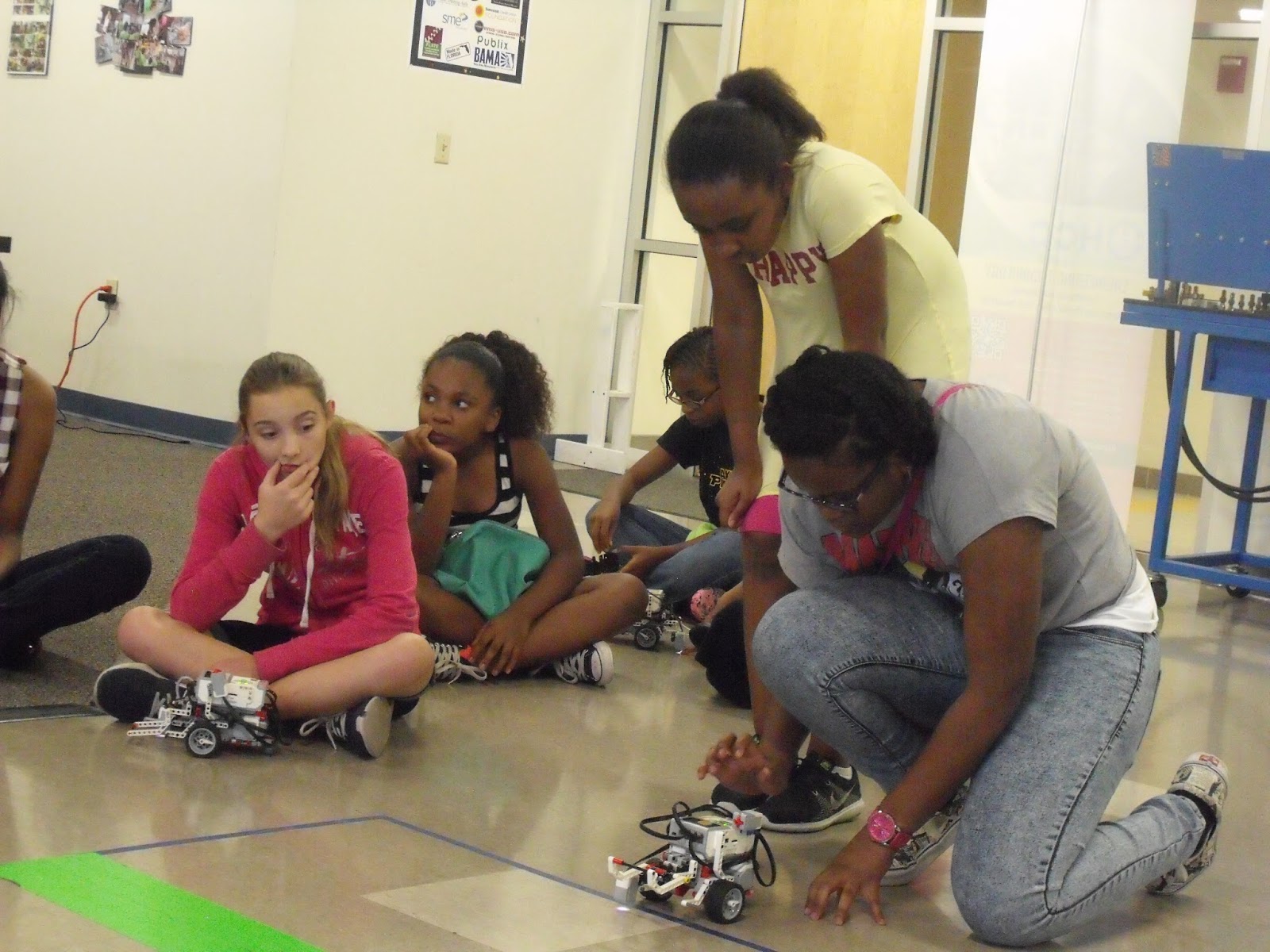
Summer Robotics Camps capture the interest and imagination of middle and high school

students by following current exciting trends in robotics and automated systems. Since the inception of the camps in 2005, FLATE’s robotics camps have provided a number of exciting opportunities for students to explore their interest in STEM and robotics and learn their application in high-tech manufacturing operations. The overarching goal being to spark middle and high school students’ interest in STEM/robotics, and more importantly encourage them to pursue related educational and career pathways. FLATE’s robotics camps provide a “STEM-ulating” experience that is targeted to foster unique experiences in advanced technology education while serving as a model for other high-tech camps to emulate.
This summer FLATE hosted four robotics camps for middle and high school students at its home campus at Hillsborough Community College. Report from the camps were published in the July and August editions of the FLATE Focus. Since the conclusion of the camps FLATE has been meticulously working on compiling survey data that is a core strength of FLATE’s efforts in measuring and gauging the effectiveness of its programs. Feedback from the camps have been overwhelmingly positive and is poised to help streamline current/future outreach and professional development programs to middle and high school students.
Outlined below are data highlights from the camps hosted onsite by FLATE at Hillsborough

Community College in Brandon. Approximately 95% of the students who responded to the post camp survey stated the robotics camps provided opportunities for teamwork and collaborations with others. Of the campers who responded to the survey, approximately 90% stated programming the robot helped them see how automated systems are programmed and controlled. Approximately 91% percent of the students who responded to the survey also stated the camp helped them better understand how science, technology, engineering, and math (STEM) are used in industry. Approximately 84% also stated learning to program the robot by thinking logically will help while solving other problems in science, technology, engineering, and math (STEM) subjects in school.
Regional camps, modeled after the FLATE robotics camps, were also held at the Institute for

Human and Machine Cognition (IHMC) at Pensacola and at Ocala. Post event survey data from regional camps showed differing responses from students, with campers placing greater emphasis on other aspects of the camps. At IHMC Pensacola, which hosted two intro level camps, 88% of the students who responded to the post event survey stated programming the robot helped them see how automated systems are programmed and controlled. The same percentage (88%) also stated the camp helped them better understand how STEM concepts are used in industry. Nearly 87% also stated the camp provided opportunities for teamwork and collaborations with others. Of the campers at IHMC Pensacola who responded to the survey nearly 84% stated learning to program the robot by thinking logically will help them while solving other problems in science, technology, engineering, and math (STEM) subjects in school.
IHMC camps in Ocala also elicited similar response. Post camp survey data shows nearly 86%

of the students who responded to the survey stated the camp provided opportunities for teamwork and collaborations with others. The same percentage (86%) also stated the camp provided opportunities for teamwork and collaborations with others. Of the campers who responded, nearly 85% stated the camp helped them better understand how STEM concepts are used by industry. Approximately 83% of the students who took the survey also stated programming the robot helped them see how automated systems are programmed and controlled.
Regional camps were also held at St. Petersburg College. Frank H. Peterson Academies in Jacksonville and at North Florida Community College in Madison. FLATE is also in the process of compiling the survey data from the high school camp and will report it when the data is available in the future. For more information about FLATE’s STEM and robotics programs visit www.fl-ate.org and www.madeinflorida.org, or visit the FLATE Wiki which has a number of free STEM resources for educators.
In 2015 Palm Beach State College was awarded a three-year National Science Foundation

InnovATE grant to create a pipeline of secondary students to enter PBSC’s Engineering Technology (ET) A.S. program, offer pathways to continue an ET education, and join local industries in high skill, high demand jobs. As part of the grant’s activities, in June 2016 PBSC offered the first year of the B.E.S.T. (Boosting Engineering Science and Technology) Summer Academy, a free three-week engineering exploration program that was held 9 a.m. to 3 p.m. every day for three weeks. Recruitment efforts to promote the program and students enrolled represented a joint effort between teachers and district employees, and included visits and presentations at local high schools about science, physics, engineering and math classes. Students came from 18 high schools from across Martin, Palm Beach and Broward counties, and were exposed to the diversity of engineering career opportunities.
Content for the camp was generally taught by Professor Oleg Andric who designed the

curriculum, Professor Lilian Jordan, Professor Becky Mercer and Professor Iran Rosenthal. The program kicked off with an innovative team building activity: a campus-wide scavenger hunt! Students were given clues to 14 stations across campus, and tasked with completing physical and mental challenges to assemble a puzzle that revealed a final problem. They even met Palmer the Panther, PBSC’s mascot, along the way!
This novel summer program included: interacting with engineers to learn about their careers,
working on hands-on projects, and touring industry sites to see engineering in action! Local companies brought their engineers to campus to give presentations, and share personal stories and advice on how to succeed in engineering. Tours included visit to local aerospace, solar and utility power companies where students saw high-tech tools and robotics, solar panels, and jet turbines. Students were also provided lunch for the entire three weeks.
B.E.S.T. students formed a diverse group with 27.5% female participation, 53% Title 1 high
schools, and 71% ethnic minority students. According to a 2012 article by Mark Crawford entitled, “Engineering Still Needs More Women,” only 14% of engineers are female, up from 5.8% in the 1980s. Further, only 5% and 6.2% of engineers are African American and Latinos, respectively (Koebler 2011). Participants learned about internships, coursework required for certain fields, and impressive entry level salaries. Hands-on projects ranged from circuits and solar-powered race cars to 3D printing and scanning, programming and bioengineering. Students worked in teams and learned to problem solve together. Along the way, they earned points and competed for the coveted title of “Best BESTer”!
The students enjoyed the experience and would like to return as volunteers next year. As one
participant put it, “I have a better understanding of engineering and have more interest in it than before BEST. It has been a fun experience that I'll never forget.” Comments like these prove a lasting impression was made and students are inspired to continue towards an engineering degree and career. Students who complete the BEST Summer Academy are now eligible for STEM scholarships at PBSC, and also participation in science fairs, and enrollment at PBSC. The InnovATE grant is focused on exposing young, diverse students to engineering, so they learn about the prospects of tomorrow’s technology and careers, and be prepared for the high job demand in this exciting field!
In addition to the robotics camp at PBSC, camps modeled after the FLATE program were also held at St. Petersburg College, the Institute for Human and Machine Cognition at Pensacola and at Ocala, Frank H. Peterson Academies in Jacksonville and at North Florida Community College which was highlighted in last month’s FLATE Focus. For more information on the Robotics Camps and the NSF innovate project at PBSC contact Ana Szogi, InnovATE Grant Coordinator at szogia@palmbeachstate.edu/561.207.5408. For information on FLATE’s STEM and robotics camps hosted every summer head on over to our Camps page http://fl-ate.org/programs/summer-camps, and/or refer to our Robotics Camp Survival Guide. Also be sure to read the previous story in this edition of the FLATE Focus that highlights the impact of robotics camps, and how the mission and goal of the camps extend beyond a summer activity, and serve as a catalyst in igniting students’ passion for STEM and robotics.
This article was written by:
Ana Szogi
NSF - InnovATE Grant Coordinator
Palm Beach State College
FLATE’s professional development initiatives for technical faculty and educators in STEM
curriculum provides opportunities to develop, refine or certify their knowledge base within manufacturing and/or its related field(s) enabling technologies and educational pedagogies. Workshops take advantage of the summer break for educators, and are offered by request throughout the year to college faculty and K-12 teachers. Earlier this summer, as part of preconference workshops at the 2016 FACTE Conference, FLATE and FAITE, the Florida Association for Industrial & Technical Educators, co-hosted the “Tech Tours”. The preconference industrial and technical tours were held on July 25, and included tours to Disney Industrial Complex, Lockheed Martin, and a launch site simulation.
A total of 20 participants, mostly educators, signed up for the tech tours and got a first-hand

look at the industrial and technical operations in each of the sites. At the “Disney Behind-the-Scenes” tour, attendees visited two independent buildings one of which housed Disney personnel responsible for maintaining, repairing, and making costumes and uniforms used in all Disney parks, hotels and resorts, including towels, blankets and customized special designed items. “It was interesting to witness the applications of STEM in a manufacturing assembly line” said Danielly Orozco, Associate Director for FLATE. The other building was a newer addition where designers created magnificent costume and apparels that breathes life to Disney cartoon characters bringing them alive. In addition to the Disney extravaganza, attendees also toured Orange Technical College where participants visited several simulation labs. The last and final tour included tours to two, Lockheed Martin facilities.
Following the FACTE preconference Tech Tours, FLATE conducted a short survey to gauge the

overall experience and feedback of attendees. Ninety five percent of respondents deemed the overall professional development value from the tours as very good/excellent. “Great tour organized to maximize impact. One of the best I have been on for industry” noted a participant in a post event survey. One hundred percent of the attendees also stated they will use the information presented at the preconference workshop, and would recommend it to their colleagues. Ninety five percent of the attendees stated that the Tech Tours increased their knowledge of the high-tech jobs, skills and opportunities available in Florida, with 100% stating the tours increased their knowledge base about how STEM subjects are applied in high-tech industrial settings. “Enjoyed the day, very interesting” stated another participant in a survey conducted by FLATE.
Visit the FLATE Wiki for more
information, or contact Executive Director of FLATE, Dr. Marilyn Barger at barger@fl-ate.org and Associate Director of FLATE, Danielly
Orozco at orozco@fl-ate.org.

 NSF work streams (curriculum, professional development, and outreach). Implementation Evaluation criteria provide a framework to: