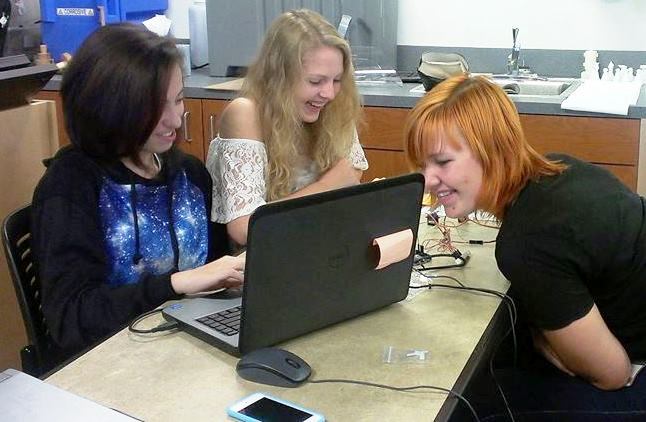
Summer is sure to be fun
with FLATE offering several robotics and engineering camps this
summer. Middle
and high school students here in the Tampa bay area and throughout Florida have
the option to choose from various options to whet their STEM appetite, with a
special “Girls Only” camp to kick off the season. The five day camps have
always been a challenging, yet fun way for campers to learn the applications of
Science, Technology, Engineering and Mathematics through hands-on activities
that focus on real-world skills in programming robots, learning about cutting
edge technologies like 3D printing and how these concepts are integrated and
applied in high-tech manufacturing operations across the state.
Since the advent of FLATE
robotics camps in 2007, the program, both in terms of the number of camp offerings
locally and regionally, and the curriculum, has greatly evolved. For the past
two years, FLATE has started using the Lego® Mindstorms® EV3 robots, where
campers have the opportunity to build and program an EV3 robot to further
augment and enhance their understanding of STEM and robotics. Camps for the
Tampa Bay area will be held at Hillsborough Community College in Brandon. Cost
for the intro and intermediate camp is $175 per week; cost for the high school
engineering and technology camp is $200 a week.
This year’s schedule and
list of camp offerings include:
June 20-24: Introductory
EV3 Robotics Camp for Middle School GIRLS ONLY!
June 27-July 1: Introductory
EV3 Robotics Camp for ALL Middle School students
July 11-15: Intermediate
EV3 Robotics Camp for ALL Middle School students
July 25-29: Engineering
Technology Camp for High School Students
The camps have
historically been a fun, educational way to “hook” students and get them
excited
about STEM and manufacturing with each camp offering different level of
challenges. Enrollment into the introductory camp requires no prior knowledge,
or experience in robotics, or programming. The intermediate camp however,
requires some basic knowledge on how to program robots. Both the intro and
intermediate camp are geared to teach students the basics of EV3 robots and how to program them. During the camp, students will learn how to build the LEGO®
Mindstorms® EV3 robots and program them to follow specific commands. They will
be part of several ‘robotic team challenges,’ learn design techniques using
software programs, see demonstrations of a 3D printer, and write programs to
operate the NAO robot.
Scholarships are
available for Girl campers with preference given to girls enrolled in the All
Girls camp. The Suncoast Credit Union Foundation is once again partnering with
FLATE to provide scholarships for girls from low-income families to attend the
All Girls camp. To qualify for the scholarship as well as apply for any of the
camps throughout this summer, please fill out the registration forms that are
currently posted on the FLATE Camps page.
The high school camp offers
an invigorating STEM-ultimate experience and offers different level
of challenges to campers compared to the intro and intermediate camps. During the
camp, students will use Solidworks and CAD to design a functional robotic arm.
They will engage in 3D printing process using additive manufacturing
techniques, and learn to program an Arduino microprocessor to operate servo
motors. Students will gain an understanding about electronics and precision
needed for building robots, learn entrepreneurial skills used by successful
business owners and tour a local advanced manufacturing facility. This year, Hillsborough County is providing
scholarships for the High School camps for low income high school
students.
Thanks to a grant from
Hillsborough County, scholarships are also available for students interested in
enrolling in the high school camp. Students from low income families, and/or
those participating in a free and reduced lunch program are eligible to apply
for the high school camp scholarship. A camp T-shirt, supplies and curriculum
will be provided for all students and is included in the registration fee. More
information on the high school camps, applications and scholarship are posted
online on the FLATE Camps website.
In addition
to the robotics camp in the greater Tampa Bay area, FLATE will also be offering
camps at
St. Petersburg College in St. Petersburg, FL, at Marion Technical
Institute in Ocala, Peterson Academy in Jacksonville, North Florida Community
College in Madison and other locations as well. Information on the camps at St.
Petersburg College in Pinellas County and Marion Technical Institute are posted
on the FLATE website under “Other Robotics Camps,” scroll to the bottom of the page to get more information
about the application process and dates of the camp. We will post more
information about the other camps across the state as dates get finalized. Additionally,
FLATE worked with contractors to develop a comprehensive summer camp
curriculum. The curriculum package for the intro and intermediate camps includes
all challenges, lessons, and PowerPoints needed to run a five day camp, and is
now available free of charge on FLATE’s Wiki http://flate.pbworks.com/w/page/10889505/FrontPage.
For more
information on FLATE’s 2016 Robotics and High School Technology camps visit www.fl-ate.org/projects/camps.html,
and www.madeinflorida.org. For camp registration and general inquiries contact Janice Mukhia at news@fl-ate.org and Dr.
Marilyn Barger at barger@fl-ate.orgbarger@fl-ate.org.


 studies across the Florida workforce spectra that included high school,
dislocated and incumbent worker training, and traditional A.S. technical
programs. From these studies and other efforts from FLATE, it is clear that
Florida has a continuum of work-based learning activities from early exposure
through company tours, classroom speakers, job shadowing through technical workplace
experience as manifested with some kind and level of internships, to registered
apprenticeships. Along this continuum there is always a requirement for commitment,
context, and contracts. As more and more
companies (as documented in Florida with the annual increase of participants on
Manufacturing Day) open their doors to
tours, they are becoming more open to taking the next step of hosting college
and high school interns.
studies across the Florida workforce spectra that included high school,
dislocated and incumbent worker training, and traditional A.S. technical
programs. From these studies and other efforts from FLATE, it is clear that
Florida has a continuum of work-based learning activities from early exposure
through company tours, classroom speakers, job shadowing through technical workplace
experience as manifested with some kind and level of internships, to registered
apprenticeships. Along this continuum there is always a requirement for commitment,
context, and contracts. As more and more
companies (as documented in Florida with the annual increase of participants on
Manufacturing Day) open their doors to
tours, they are becoming more open to taking the next step of hosting college
and high school interns.